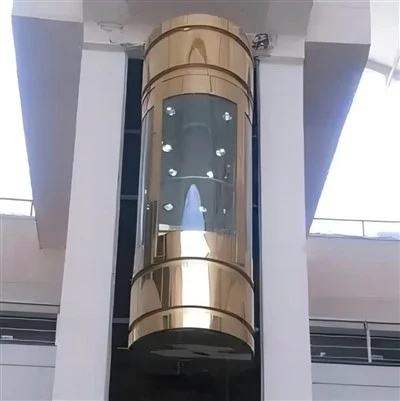
Do Vacuum Passenger Lifts have a smooth ride?
As a supplier of vacuum passenger lifts, I've been frequently asked whether these innovative vertical transportation systems offer a smooth ride. In this blog, I'd like to delve into the technical aspects, compare them with traditional lifts, and share real - world experiences to answer this question comprehensively.
The Technology Behind Vacuum Passenger Lifts
Vacuum passenger lifts operate on a completely different principle compared to conventional cable - based or hydraulic lifts. At the heart of a vacuum lift is the use of air pressure differentials. The lift car is essentially a sealed chamber that moves within a vertical tube. When air is removed from the space above the car, creating a partial vacuum, the higher air pressure below the car pushes it upwards. Conversely, to move downwards, air is carefully introduced back into the upper part of the tube, allowing the car to descend under controlled conditions.
This technology has several inherent features that contribute to a potentially smooth ride. First of all, there are no cables or pulleys involved. In traditional cable - driven lifts, the cables can sometimes experience vibrations due to uneven tension, wear and tear, or the movement of the counterweight. These vibrations can be transferred to the lift car, resulting in an uncomfortable ride. With vacuum lifts, the absence of cables eliminates this source of vibration.
Secondly, the movement of the lift car is more linear and controlled. The air pressure differential provides a consistent force that acts evenly on the car, ensuring a stable ascent and descent. The control systems in modern vacuum lifts are highly advanced, allowing for precise regulation of the air pressure changes. This means that the acceleration and deceleration of the lift car can be finely tuned to provide a smooth transition between stationary and moving states.
Comparing with Traditional Lifts
Let's take a look at how vacuum passenger lifts stack up against traditional commercial passenger lifts Commercial Passenger Lift and small passenger elevators Small Passenger Elevator.
In the case of hydraulic lifts, they rely on a piston - cylinder system to move the lift car. While hydraulic lifts are known for their smooth operation at lower speeds, they can be less efficient at higher speeds. The hydraulic fluid can also experience temperature - related fluctuations, which may affect the smoothness of the ride. Additionally, the mechanical components in hydraulic lifts, such as valves and pumps, can wear out over time, leading to potential vibrations and jerks.


Cable - driven lifts, on the other hand, are widely used in high - rise buildings. However, as mentioned earlier, the cables can introduce vibrations. Moreover, the counterweight system in cable - driven lifts needs to be carefully balanced. Any imbalance can cause the lift car to sway during movement, resulting in an unsteady ride.
Vacuum passenger lifts, in contrast, offer a more consistent and vibration - free experience. Their simple design with fewer moving parts reduces the chances of mechanical failures that could disrupt the smooth operation. The air - based propulsion system provides a gentle and continuous force, making the ride more comfortable for passengers.
Real - World Experiences
To further validate the smoothness of vacuum passenger lifts, let's look at some real - world examples. In many modern residential buildings where space is a premium, small passenger elevators Small Passenger Elevator are often installed. Vacuum passenger lifts are a popular choice in such settings. Homeowners have reported that the ride is incredibly smooth, almost imperceptible in terms of movement. The quiet operation of the lift also adds to the overall comfort, as there are no noisy cables or hydraulic pumps.
In commercial settings, such as small offices or boutique hotels, vacuum passenger lifts have also received positive feedback. Passengers appreciate the smooth acceleration and deceleration, which is especially important in busy environments where people are in a hurry. The stability of the lift car during movement gives passengers a sense of security, which is crucial for a positive user experience.
Factors Affecting the Smoothness of the Ride
While vacuum passenger lifts are designed to provide a smooth ride, there are still some factors that can potentially affect their performance. One of the key factors is the installation process. A proper installation is essential to ensure that the lift operates smoothly. The vertical tube needs to be perfectly aligned, and the airtight seals around the lift car and the tube must be intact. Any misalignment or leakage can lead to uneven air pressure distribution, which may cause the lift car to move erratically.
Maintenance is another important factor. Regular maintenance of the vacuum system, including checking the air pumps, valves, and sensors, is necessary to keep the lift in optimal condition. Over time, dust and debris can accumulate in the system, affecting the efficiency of the air pressure changes. By performing routine maintenance, any potential issues can be identified and resolved before they impact the smoothness of the ride.
Conclusion
In conclusion, vacuum passenger lifts generally offer a smooth ride. Their unique air - pressure - based technology eliminates many of the sources of vibration and instability associated with traditional lifts. The linear and controlled movement, along with advanced control systems, ensures a comfortable experience for passengers. However, proper installation and maintenance are crucial to maintaining the smoothness of the ride over time.
If you're considering installing a passenger elevator in your building, whether it's a commercial space or a residential property, vacuum passenger lifts are definitely worth considering. Our company specializes in providing high - quality vacuum passenger lifts that are designed to meet your specific needs. We have a team of experts who can guide you through the installation and maintenance process to ensure that you get the best performance from your lift.
If you're interested in learning more about our vacuum passenger lifts or have any questions regarding the installation and operation, we encourage you to contact us for a procurement discussion. We look forward to working with you to provide a smooth and efficient vertical transportation solution for your building.
References
- "Elevator Technology Handbook" - A comprehensive guide on different types of elevator technologies, including vacuum lifts.
- Industry reports on the performance and user feedback of vacuum passenger lifts in various building applications.