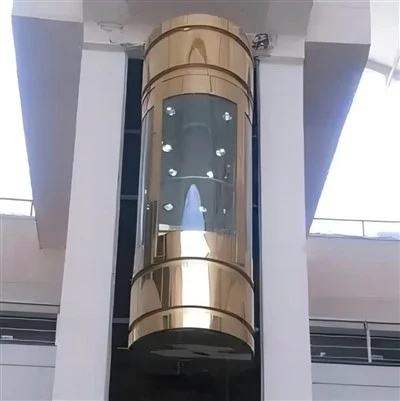
As a supplier of traction passenger lifts, I'm often asked about how these sophisticated machines work. In this blog, I'll delve into the inner workings of traction passenger lifts, shedding light on the technology that makes vertical transportation in modern buildings both efficient and safe.
Basic Principles of Traction Passenger Lifts
Traction passenger lifts operate on the fundamental principle of counterweights and ropes. Unlike Hydraulic Passenger Lift, which use a hydraulic piston to move the elevator car up and down, traction lifts rely on a system of ropes and a motor to hoist and lower the car.
At the heart of a traction lift system is the drive machine, typically an electric motor. This motor is connected to a sheave, which is a large pulley with grooves. The ropes are wound around the sheave, and one end of the ropes is attached to the elevator car, while the other end is connected to a counterweight.
The Role of the Counterweight
The counterweight plays a crucial role in the operation of a traction passenger lift. It is designed to balance the weight of the elevator car and a portion of its load. Typically, the counterweight is equal to the weight of the empty car plus about 40 - 50% of the rated load.
This balance reduces the amount of energy required to move the elevator car. When the elevator is going up, the motor only needs to overcome the difference in weight between the car and the counterweight. Similarly, when the elevator is going down, the counterweight helps to control the speed of the descent, reducing the load on the braking system.
Rope and Sheave System
The ropes used in traction passenger lifts are made of high - strength steel. They are designed to withstand the heavy loads and constant stress associated with elevator operation. The number of ropes used in a lift system can vary depending on the size and capacity of the elevator, but most modern lifts use multiple ropes for safety reasons.
The sheave is carefully designed to match the ropes. The grooves in the sheave are shaped to grip the ropes securely without causing excessive wear. As the motor rotates the sheave, the ropes move, either raising or lowering the elevator car and the counterweight.
Control System
The control system of a traction passenger lift is responsible for managing the movement of the elevator. It includes a controller, which receives signals from various sensors and buttons inside and outside the elevator car.
When a passenger presses a button on a floor or inside the car, the controller analyzes the request and determines the best way to route the elevator. It takes into account factors such as the current position of the elevator, the direction of travel, and the number of pending requests.
The control system also ensures that the elevator operates smoothly and safely. It regulates the speed of the elevator, monitors the position of the car, and activates the braking system if necessary.
Safety Features
Safety is of utmost importance in the design and operation of traction passenger lifts. There are several safety features built into these systems to protect passengers.
One of the most important safety features is the overspeed governor. This device monitors the speed of the elevator car and, if the speed exceeds a certain limit, it activates a braking mechanism to stop the car.
Another safety feature is the safety brakes. These brakes are designed to hold the elevator car in place in case of a power failure or other emergency. They are typically located on the drive machine or the elevator car itself.
In addition, traction passenger lifts are equipped with door interlocks. These interlocks ensure that the elevator doors cannot open unless the car is at a landing and properly aligned. This prevents passengers from accidentally stepping into an empty shaft.
Installation and Maintenance
Installing a traction passenger lift is a complex process that requires careful planning and precise engineering. The elevator shaft must be constructed to the exact specifications of the lift, and the drive machine, ropes, and other components must be installed correctly.


Once the lift is installed, regular maintenance is essential to ensure its safe and efficient operation. Maintenance tasks include inspecting the ropes for wear and damage, lubricating the moving parts, and testing the safety features.
As a supplier, we provide comprehensive installation and maintenance services. Our team of experienced technicians is trained to install and maintain traction passenger lifts to the highest standards.
Advantages of Traction Passenger Lifts
Traction passenger lifts offer several advantages over other types of lifts. One of the main advantages is their energy efficiency. The use of counterweights reduces the amount of energy required to move the elevator car, resulting in lower operating costs.
Traction lifts also have a higher speed capacity compared to Hydraulic Passenger Lift. They are suitable for high - rise buildings where fast vertical transportation is required.
In addition, traction passenger lifts are more environmentally friendly. They do not use hydraulic oil, which can be a source of pollution if it leaks.
Applications
Traction passenger lifts are widely used in various types of buildings, including commercial buildings, residential buildings, and public facilities.
In commercial buildings such as offices and shopping malls, traction lifts provide fast and efficient vertical transportation for employees and customers. They can handle a large number of passengers and are designed to operate smoothly and quietly.
In residential buildings, traction lifts offer convenience for residents, especially in high - rise apartments. They enhance the quality of life by providing easy access to different floors.
Public facilities such as hospitals and airports also rely on traction passenger lifts to transport people quickly and safely. These lifts are often designed with special features to meet the specific needs of these environments, such as wheelchair accessibility and emergency evacuation capabilities.
Customization Options
As a supplier, we understand that different customers have different requirements. That's why we offer a wide range of customization options for our traction passenger lifts.
We can customize the size and capacity of the elevator car to fit the specific needs of the building. We also offer a variety of finishes and interior designs to match the aesthetic of the building.
In addition, we can integrate advanced features such as destination control systems, which improve the efficiency of elevator operation by grouping passengers with similar destinations.
Contact Us for Purchase and Negotiation
If you're interested in purchasing a traction passenger lift for your building, we'd be more than happy to discuss your requirements. Our team of experts can provide you with detailed information about our products, including specifications, pricing, and installation options.
Whether you need a standard lift or a customized solution, we have the expertise and experience to meet your needs. Contact us today to start the procurement negotiation process and take the first step towards efficient and safe vertical transportation in your building.
References
- “Elevator Technology Handbook” by Wolfgang A. Halang.
- “Vertical Transportation Handbook” by Joseph F. Peters.