


Elevator definition and classification
Definition
According to the "Special Equipment Catalog," an elevator is a power-driven electromechanical device that uses a car running along rigid guide rails or steps running along a fixed route to lift or transport people or goods horizontally. This includes passenger (freight) elevators, escalators, and moving walkways. Elevators installed in non-public places and intended for single-family use are excluded.
In other words, elevators, escalators, and moving walkways are collectively referred to as elevators.
Classification
According to the "Special Equipment Catalog," elevators are divided into 4 categories and 10 types:
(1) Traction Drive: Elevators that use friction between the traction sheave groove and the traction wire rope to move the car and counterweight at both ends of the wire rope up or down. Most electrically driven elevators currently use this drive method.
(2) Forced Drive: Elevators that use a winch-driven mechanism to raise and lower the car by winding the wire rope around a drum. This type of elevator has a simpler structure, but its travel distance is shorter due to the limited rope capacity of the drum, and over-winding can easily break the wire rope, so it is less commonly used.
(3) Hydraulic Drive: Hydraulic elevators use an electrically driven hydraulic pump to deliver hydraulic oil to the hydraulic cylinder, directly or indirectly driving the car. They are commonly used in situations with large loads, slow speeds, and short travel distances, such as parking lots, factories, and low-rise buildings.
(4) Passenger Elevator: Elevators designed to transport passengers. Their characteristics include: safe and comfortable operation, novel and aesthetically pleasing decoration; to facilitate passenger entry and exit and rapid evacuation, the width of the car is generally larger than its depth, with a ratio of approximately 10:7 to 10:9.
(5) Freight Elevator: Usually staffed, this type of elevator is primarily designed for transporting goods. Its characteristics include: robust structure; relatively low rated speed to save investment and ensure good leveling accuracy; and a relatively large car volume, generally with the depth greater than or equal to the width.
Note: There are no regulations prohibiting freight elevators from carrying passengers, but considering the heavy counterweight, which can easily cause overloading, freight elevators are usually staffed with passengers and should not be used for solo passenger transport.
(6) Explosion-proof Elevator: Generally, elevators with explosion-proof properties are called explosion-proof elevators. The principle of explosion-proof elevators is the same as that of ordinary elevators, except that in addition to the necessary performance characteristics of ordinary elevators, they must also have explosion-proof properties. They are commonly used in chemical production plants.
(7) Firefighter Elevator: A firefighter elevator is an elevator installed within a fire-resistant, enclosed structure of a building, equipped with an anteroom and backup power supply. Under normal circumstances, it is used by ordinary passengers. However, in the event of a fire, its additional protection, control, and signaling functions are dedicated to firefighters, transporting them and their equipment to designated floors, thereby improving operational efficiency and conserving firefighters' energy.

Note: Ordinary elevators with "fire switches" at the entrance of the landing doors are only equipped with "fire emergency landing" functions and are not firefighter elevators. Their operating principle is as follows: when a fire occurs in a building, pressing the "fire switch" triggers the elevator to receive the fire command. It then proceeds directly to the first floor (or the floor where the base station is located) and stops responding to elevator call signals. The car door and landing door open simultaneously and remain open, indicating a stopped operation. Passengers inside the elevator should evacuate immediately and are not allowed to enter or use the elevator.
(8) Service elevator: A fixed lifting device serving a designated floor. It has a car, the structure and size of which do not allow personnel to enter. To ensure that personnel cannot enter, the car dimensions should not exceed: a. Car floor area 1.0㎡; b. Depth 1.0m; c. Height 1.20m. The dumbwaiter used in restaurants is the most common type of service elevator.
Basic structure and working principle of elevators
Basic Structure
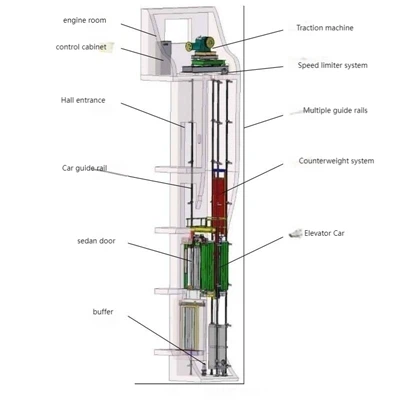
An elevator generally consists of four parts: machine room, hoistway, car, and landings. In other words, an elevator occupies four main spaces:
(1) The machine room includes power switches, control cabinet, traction machine, guide wheels, speed governor, etc.;
(2) The hoistway includes guide rails, guide rail supports, counterweight, buffer, speed governor tensioning device, compensating chain, traveling cable, pit, hoistway lighting, etc.;
(3) The landings include landing doors, call devices, door lock devices, landing door opening and closing devices, floor display devices, etc.;
(4) The car includes the car, car door, safety brake device, leveling device, safety window, guide shoes, door opener, car control panel, floor indicator lights, communication alarm devices, etc.

Working Principle
Traction-driven elevators are currently the most widely used type of vertical elevator. The working principle is very simple. The traction machine, consisting of a motor, gearbox, brake, etc., installed in the machine room, acts as the drive mechanism. A steel wire rope is suspended from the sheave of the traction machine, with one end suspending the car and the other end suspending the counterweight. The weight of the car and counterweight causes the traction rope to press against the grooves of the traction sheave, generating friction. When the traction machine rotates, the friction between the steel wire rope and the sheave generates traction force, causing the elevator car and counterweight at both ends of the steel wire rope to move up or down-the car goes up, the counterweight goes down; the counterweight goes up, the car goes down. Thus, the car moves up and down along the guide rails in the hoistway, and the elevator performs the vertical transportation task. To ensure the elevator's safety, comfort, and efficiency, it must also be equipped with various safety protection devices, door systems, electric drive systems, electrical control systems, etc.
Elevator main parameters
The main parameters of a passenger (freight) elevator are: rated speed (m/s), rated load capacity (kg), and number of floors.
(1) Rated speed: refers to the speed specified in the elevator design. Common rated speeds include 0.25, 0.40, 0.63, 1.00, 1.60, 2.50, 3.5, and 4.0 m/s.
(2) Rated load capacity: refers to the maximum load inside the elevator car specified in the elevator design. Common rated load capacities include 320, 400, 630, 800, 1000, 1250, 1600, 2000, 2500, 3000, and 5000 kg.
(3) Floors: refers to the locations on each floor used for entering and exiting the elevator car. Each floor is defined by the location for entering and exiting the car, and the building floors along the elevator's travel distance are called floors. If the elevator actually travels 15 floors and has 11 doors for passengers to exit the elevator car, then the number of floors and stops is 15 floors and 11 stops.


