


Modern healthcare facilities-ranging from general hospitals, surgical centers, and maternity clinics to rehabilitation institutes and nursing homes-rely heavily on uninterrupted, safe, and hygienic vertical transportation. Unlike standard commercial passenger lifts designed for brief office commutes, medical bed elevators must transport full-sized hospital beds, emergency stretchers, portable life-support equipment, and accompanying doctors or nurses without jarring stops, vibration, or narrow doorway bottlenecks.
Over the past two decades, China has built one of the world's most complete elevator manufacturing ecosystems, supplying both domestic hospital infrastructure and international healthcare construction projects across Asia, the Middle East, Europe, Africa, and Latin America. For hospital developers, EPC contractors, and procurement teams sourcing a dependable hospital pattern elevator, evaluating Chinese manufacturers requires looking closely at millimeter-level floor leveling, antimicrobial cabin finishes, emergency backup power integration, and compliance with international safety codes such as EN 81-20/50 and ASME A17.1.
This comprehensive buyer's guide examines China's elevator manufacturing clusters, outlines the core engineering criteria for healthcare lifts, reviews 10 prominent hospital elevator manufacturers in China, and provides a practical procurement and export inspection checklist for medical building projects.
Important: Healthcare building codes, elevator safety standards, and accessibility requirements differ by country, jurisdiction, and facility classification. Always verify exact technical parameters and local code compliance with qualified project engineers before finalizing equipment specifications.
Why Global Healthcare Builders Source Hospital Elevators from China
China accounts for more than half of global elevator production and installation volume, creating deep supply-chain maturity across traction machines, microprocessor controllers, door operators, guide rails, and stainless-steel cabin fabrication. For overseas medical construction projects, this industrial scale translates into several practical advantages:
Concentrated Manufacturing Clusters: Major production hubs in the Yangtze River Delta (Suzhou, Kunshan, Huzhou, Shanghai, and Ningbo) and the Pearl River Delta (Guangzhou and Zhongshan) bring component suppliers, testing towers, and export logistics ports within close proximity, shortening production lead times.
Non-Standard Shaft & Cabin Flexibility: Hospital renovations and regional medical centers frequently involve irregular hoistways, tight pit depths, or custom door clear widths. Export-oriented Chinese factories offer strong OEM/ODM engineering flexibility compared to rigid catalog-only suppliers.
International Code Alignment: Leading Chinese manufacturers routinely engineer systems to meet European EN 81-20/50, North American ASME A17.1 / CSA B44, and regional Middle Eastern or Southeast Asian healthcare regulations, supported by CE certification and third-party factory audits.
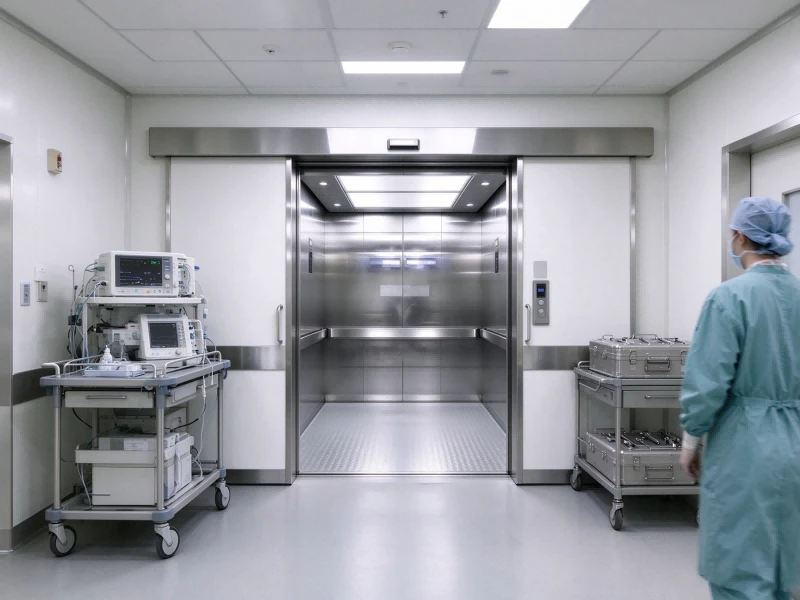
Core Engineering Criteria for Modern Medical Elevators
Before comparing individual suppliers, hospital architects, MEP consultants, and procurement managers should define clear technical benchmarks around clinical safety and daily operational efficiency:
1. Millimeter-Accurate Floor Leveling: When rolling wheeled hospital beds, surgical stretchers, or sensitive mobile imaging carts across the landing threshold, even a slight vertical step can jolt patients or dislodge intravenous lines. Quality medical elevators integrate high-resolution rotary encoders and closed-loop leveling control to keep floor alignment accurate within a few millimeters under varying load conditions.
2. Ultra-Smooth VVVF Drive & Low-Vibration Hoisting: Post-operative and trauma patients are highly sensitive to sudden acceleration, deceleration, or mechanical vibration. Modern permanent magnet synchronous (PMS) gearless traction machines paired with S-curve variable-voltage variable-frequency (VVVF) controllers deliver quiet, stepless velocity transitions and stable low-speed travel.
3. Hygienic & Antimicrobial Cabin Construction: Infection prevention is central to hospital planning. Medical elevator cabins should feature hairline or brushed 304/316 stainless steel walls, optional antimicrobial surface coatings, seamless PVC or stone-composite flooring, coved interior corners that prevent dust accumulation, and indirect glare-free LED lighting that will not shine directly into a lying patient's eyes.
4. Hospital-Specific Priority & Emergency Controls: Unlike standard passenger lifts, medical elevators require key-operated hospital service switches, non-stop emergency priority dispatch for trauma transfers, extended door-open dwell timers, full-height infrared light curtains to prevent door contact with beds, and Automatic Rescue Devices (ARD) connected to building backup power.
Top 10 Hospital Elevator Manufacturers in China
1. Suzhou Volkspace Intelligent Equipment Co., Ltd. (VOLK): Headquartered in Suzhou, Jiangsu Province-the heart of China's precision elevator manufacturing belt-VOLK focuses on engineered vertical transportation systems for healthcare facilities, commercial complexes, and residential projects worldwide. VOLK prioritizes ride smoothness, precision floor leveling, low acoustic output, and durable hygienic cabin interiors constructed from easy-to-sanitize stainless steel with protective crash rails. For international hospital developers and EPC contractors, the VOLK hospital pattern elevator series provides extensive engineering customization across shaft dimensions, wide center-opening or two-speed side-opening doors, through-car configurations, and specialized medical control functions aligned with local healthcare building codes.
2. Canny Elevator Co., Ltd.: Founded in 1997 in Suzhou, Canny Elevator is one of China's largest publicly listed domestic elevator brands, supported by high-speed testing towers and automated sheet-metal production lines. Canny's medical bed elevator series is built for high-frequency general hospitals, incorporating heavy-duty car frames, energy-efficient gearless traction drives, intelligent group-control dispatching, and optional contactless hall call panels.
3. Hitachi Elevator (China) Co., Ltd.: Based in Guangzhou, Hitachi Elevator (China) is a leading Sino-Japanese joint venture supplying large-scale public hospitals, university medical centers, and regional healthcare campuses. Known for drive reliability and IoT-enabled predictive maintenance, Hitachi integrates smooth deceleration algorithms, cabin air sterilization modules, and barrier-free accessibility controls suited for multi-tower medical complexes.
4. KONE Elevators Co., Ltd. (China): Operating major manufacturing and R&D campuses in Kunshan, Jiangsu, KONE China delivers vertical transportation solutions for green-certified and smart hospital developments. KONE's medical bed elevators highlight machine-room-less (MRL) architectural space savings, low-vibration hoisting systems, and antimicrobial cabin surface treatments engineered for continuous clinical traffic.
5. Mitsubishi Electric Shanghai Mechanical & Electrical Elevator Co., Ltd.: With major manufacturing operations in Shanghai, Mitsubishi Electric is widely respected across healthcare projects for strict quality control and ride comfort. Its medical bed elevators emphasize precision leveling stability, quiet door operators, and long-life mechanical assemblies built for demanding 24/7 emergency and inpatient operations.
6. TK Elevator (China): Supported by modern manufacturing facilities in Shanghai and Zhongshan, TK Elevator brings German engineering methodologies to China's healthcare building sector. Its hospital elevator portfolio focuses on barrier-free ergonomics, redundant safety braking systems, and smart destination dispatching that minimizes patient transfer waiting times during peak outpatient hours.
7. Ningbo Hosting Elevator Co., Ltd.: Established in 1993 in Ningbo, Zhejiang Province, Hosting Elevator manufactures a comprehensive range of passenger, freight, panoramic, and medical bed elevators for both domestic institutions and overseas distributors. Their hospital elevator models feature customizable cabin depths, microprocessor fault diagnostics, and practical configurations tailored to mid-rise clinics and regional hospitals.
8. General Elevator Co., Ltd.: Headquartered in Suzhou, General Elevator specializes in intelligent vertical transportation manufacturing and customized engineering projects. Its healthcare elevator line incorporates permanent magnet synchronous gearless drives, emergency power-failure auto-leveling, and configurable stainless-steel handrails and wall bumper guards to protect interiors from wheeled stretchers.
9. Huzhou Fuji Elevator Co., Ltd.: Located in Huzhou, Zhejiang Province, Huzhou Fuji Elevator produces diverse lift categories including specialized medical and bed elevators for international builders and OEM partners. The manufacturer offers adaptable engineering for non-standard hoistway sizes and low-pit or low-overhead site constraints, making its lifts suitable for clinic retrofits as well as new hospital wings.
10. SAIL Intelligent Elevator (Suzhou) Co., Ltd.: Operating out of Wujiang, Suzhou, SAIL Intelligent Elevator focuses on integrated elevator control systems and complete lift packages for medical and commercial buildings. Its hospital elevator configurations feature smooth S-curve speed regulation, wide clear door openings, and straightforward component accessibility for long-term facility maintenance.
Global Joint Ventures vs. Specialized Export Manufacturers
When shortlisting Chinese elevator manufacturers for an international medical project, procurement teams generally evaluate two distinct supplier tiers. Understanding their operational differences helps align supplier selection with budget, timeline, and customization requirements:
Engineering & Code Flexibility: Global joint-venture brands rely on standardized international platforms suited for flagship megaprojects, while specialized export manufacturers like VOLK tailor a hospital pattern elevator directly to EN, ASME, or local regional healthcare codes.
Non-Standard Shaft & Door Customization: Global platforms typically follow fixed catalog dimensions, whereas specialized manufacturers provide agile customization for irregular hoistways, wider door clearances, and custom cabin depths.
Drawing Turnaround & Production Lead Time: Export-focused factories deliver faster general arrangement (GA) drawings and shorter manufacturing schedules compared to multi-layered multinational approval processes.
Total Cost of Ownership & Serviceability: Specialized export manufacturers offer factory-direct pricing and open-protocol spare parts, avoiding expensive proprietary diagnostic tools over a 20-year building lifecycle.
For regional hospitals, private medical centers, surgical clinics, and EPC contractors working under fixed construction budgets and tight handover schedules, specialized export manufacturers frequently deliver the strongest balance of engineering customization and lifecycle value.
Door Configurations, Cabin Dimensions, and Clinical Options
Selecting the right mechanical layout is essential to prevent bottlenecks between emergency rooms, operating theaters, imaging suites, and inpatient wards. When reviewing supplier proposals, confirm the following configuration details:
Clear Door Opening Width & Door Type: Standard passenger doors (800 mm to 900 mm) cannot accommodate hospital beds with side rails and attached IV poles. Medical bed elevators typically specify clear door widths of 1,100 mm, 1,200 mm, or wider depending on local regulations. Two-speed side-opening doors are widely used to maximize clear opening width within a narrower shaft width, while center-opening doors provide faster opening cycles where hoistway width permits.
Deep Rectangular Cabin Proportions: Unlike square office elevator cabins, medical bed elevators use deep rectangular footprints (such as 1,400 mm x 2,400 mm or 1,500 mm x 2,700 mm, subject to rated load and local code) so a full-length hospital bed can enter straight in while leaving room at the head or foot for attending staff and portable monitors.
Single-Entrance vs. Through-Type (Front-and-Rear) Layout: In surgical departments or busy emergency corridors, through-type cabins with opposite entrances allow beds to roll straight in on one side and exit forward on the destination floor without turning or backing out, improving patient safety and infection-zone separation.
Interior Protection & Accessibility Features: Specify dual-height stainless-steel handrails, heavy-duty PVC or rubberized bumper rails along lower cabin walls to absorb stretcher impacts, braille tactile buttons at wheelchair-accessible heights, voice floor announcements, and soft indirect ceiling diffusers.
Export Packaging, Quality Inspection, and Installation Support
Sourcing heavy vertical transportation equipment across borders requires structured quality verification and logistics planning to ensure smooth on-site installation:
Pre-Production General Arrangement (GA) Approval: Before manufacturing starts, the supplier should issue detailed GA drawings showing exact shaft dimensions, reaction forces on the machine-room slab or hoistway walls, pit depth, overhead clearance, and electrical power requirements for sign-off by your structural and MEP engineers.
Key Component Traceability: Verify the brand, model, and safety certification of core subsystems-including the permanent magnet gearless traction machine, microprocessor controller, VVVF inverter, door operator, overspeed governor, and progressive safety gear.
Pre-Shipment Factory Testing & Seaworthy Packaging: Reliable manufacturers conduct pre-delivery functional testing on controllers and door operators, provide detailed packing lists mapped to installation phases, and pack components in fumigation-free plywood crates with moisture barriers and steel strapping for ocean container transport.
Installation Manuals & Remote Commissioning Guidance: Ensure the manufacturer supplies complete English wiring diagrams, mechanical assembly manuals, spare-part kits for commissioning, and responsive remote engineering support to assist your local installation team.
Practical Procurement Checklist and VOLK Project Coordination
VOLK partners with hospital developers, architectural firms, EPC contractors, and elevator distributors to deliver coordinated medical lift packages. Preparing the following project details before requesting a quotation ensures accurate technical proposals:
1. Facility Type & Governing Codes: Specify whether the project is a general hospital, surgical center, outpatient clinic, or nursing home, along with applicable national or regional elevator codes.
2. Bed & Medical Equipment Envelope: Confirm the maximum width, length, and height of the beds, stretchers, and mobile medical carts that will use the elevator.
3. Shaft & Building Dimensions: Provide clear hoistway width and depth, pit depth, overhead height, machine-room or MRL preference, number of floors/stops, and total travel height.
4. Rated Load, Speed & Power Supply: Define target capacity (typically 1,600 kg to 2,500 kg for full bed elevators, subject to local regulations), rated speed, and local three-phase voltage/frequency.
5. Door & Clinical Specifications: Indicate single or through-type entrances, clear door width and height, hospital attendant controls, emergency backup power integration, antimicrobial finishes, and protective bumper rails.

FAQ
Q1: What makes a hospital pattern elevator different from a standard passenger elevator?
A hospital pattern elevator is engineered with a deeper rectangular cabin and wider clear door opening to fit wheeled hospital beds, stretchers, portable medical equipment, and accompanying staff. It also prioritizes ultra-smooth VVVF acceleration, millimeter-accurate floor leveling, hygienic stainless-steel finishes, protective wall bumpers, and dedicated hospital priority controls.
Q2: What rated load capacity is typically specified for hospital bed elevators?
Depending on local building codes and bed dimensions, full-size medical bed elevators commonly range from 1,600 kg to 2,500 kg. Smaller outpatient clinics or rehabilitation centers transporting wheelchairs or compact stretchers may specify lower capacities in accordance with applicable regional standards.
Q3: Should healthcare buildings choose Machine-Room-Less (MRL) or Machine-Room (MR) hospital elevators?
Both configurations are used in healthcare facilities. MRL hospital elevators save rooftop construction space and integrate cleanly into mid-rise medical buildings, while MR hospital elevators can be advantageous for higher travel heights, heavier rated loads, or easier technician access outside the hoistway during maintenance.
Q4: Can Chinese elevator manufacturers customize dimensions for existing hospital shafts?
Yes. Many export-focused manufacturers in China, including VOLK, provide custom engineering to adapt cabin dimensions, two-speed side-opening doors, and guide rail brackets to existing concrete or steel shafts during hospital modernization projects.
Q5: What safety and emergency features are essential in medical elevators?
Essential features include full-height infrared door light curtains, Automatic Rescue Devices (ARD) that bring the car to the nearest floor and open doors during a power outage, hospital attendant key switches, non-stop emergency call priority, fireman's emergency operation, and two-way hands-free emergency intercoms.
Q6: How long does it take to manufacture and ship a hospital elevator from China?
Typical manufacturing lead times range from 30 to 45 days after final general arrangement (GA) drawing approval and deposit confirmation, depending on customization complexity, followed by ocean transit time to the destination port.
Q7: How do international buyers verify quality before shipping a hospital elevator from China?
Buyers should review CE and ISO 9001 certifications, approve detailed GA and electrical drawings prior to production, verify key component brands (traction machine, controller, door operator, and safety gear), and request pre-shipment factory inspection photos, test reports, or third-party inspection audits.
Conclusion
Selecting the right manufacturing partner is critical to ensuring safe, quiet, and reliable patient transport throughout a healthcare facility's lifecycle. By evaluating drive smoothness, millimeter-level leveling accuracy, hygienic cabin construction, and non-standard customization support alongside your architectural plans, project teams can prevent costly shaft conflicts and clinical workflow bottlenecks.
If you are planning a new medical facility or upgrading vertical transportation in an existing healthcare building, share your architectural drawings, shaft dimensions, and applicable standards with VOLK to configure a tailored hospital pattern elevator solution engineered for dependable clinical performance.


