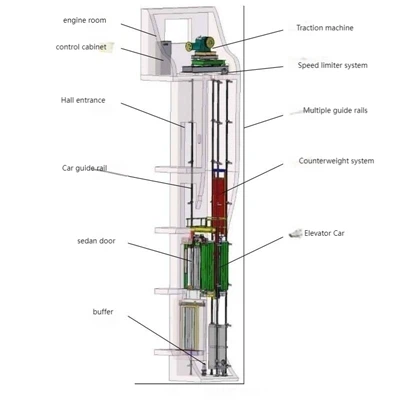
Hotel Elevator, Provide elevator solutions for various types
We are a professional hotel passenger elevator manufacturer specializing in traction and MRL systems for 3–5 star hospitality projects across the Middle East, Southeast Asia, and Africa. Our solutions range from 800kg to 1600kg, with speeds up to 3.5 m/s, featuring VVVF drive, energy-saving control systems, and customized cabin interiors. With strict quality control, export-standard compliance, and project-based engineering support, we deliver reliable vertical transportation tailored to hotel traffic and comfort requirements.

1. Types of Hotel Passenger Elevators
Different hotel categories and building heights require different elevator technologies. The most common types include:
1.1 Traction Elevator (Geared or Gearless)
Traction systems are the primary solution for mid- and high-rise hotels.
Key features:
Suitable for 4–40+ floors
Speed range: 1.0 m/s to 4.0 m/s
Smooth acceleration and deceleration
High energy efficiency (especially gearless with VVVF control)
For hotels above 6 floors, traction elevators are generally the preferred solution due to better ride comfort and higher travel speeds.
1.2 Machine Room-Less (MRL) Elevator
MRL systems are widely adopted in Southeast Asia and African urban projects where construction cost control and space optimization are critical.
Advantages:
No separate machine room
Reduced building height
Lower civil construction cost
Energy-saving permanent magnet motors
MRL hotel passenger elevator systems are typically used for:
4–15 floors
Speeds up to 1.75 m/s
Medium-traffic hotels
1.3 High-Speed Elevator
In luxury towers in cities such as Dubai, Riyadh, and Jakarta, high-speed elevators are required for premium guest experience.
Typical specifications:
Speed: 2.5–4.0 m/s
Advanced group control system
Destination dispatch (optional)
Noise < 55 dB
High-speed systems are usually reserved for 5-star and mixed-use hotel towers.
2. Hotel Passenger Elevator Configuration by Star Rating
Elevator planning must align with hotel positioning, room count, occupancy rate, and peak traffic periods (check-in, check-out, conference breaks).
2.1 3-Star Hotels
Typical characteristics:
4–10 floors
60–120 rooms
Moderate peak traffic
Recommended configuration:
2 passenger elevators
800–1000 kg capacity (10–13 persons)
Speed: 1.0–1.6 m/s
MRL preferred for cost efficiency
Service elevator may be shared depending on layout.
2.2 4-Star Hotels
Typical characteristics:
8–20 floors
120–250 rooms
Business and tourism mix
Recommended configuration:
2–3 passenger elevators
1000–1350 kg capacity
Speed: 1.6–2.0 m/s
Independent service elevator (1600 kg recommended)
For Southeast Asia and Middle East resort projects, separate guest and service circulation is strongly recommended to maintain operational standards.
2.3 5-Star and Luxury Hotels
In premium developments across Doha, Kuala Lumpur, and Nairobi, elevator systems directly influence brand perception.
Typical characteristics:
20–50+ floors
250+ rooms
Conference facilities
VIP floors
Recommended configuration:
3–6 passenger elevators (group control)
1350–1600 kg capacity
Speed: 2.0–3.5 m/s
Dedicated VIP elevator (optional)
Destination control system
Separate service and kitchen elevators
Waiting time target:
Average waiting time < 30 seconds
Handling capacity ≥ 12–15% of population in 5 minutes
3. Traffic Analysis and Planning Considerations
For a hotel passenger elevator system, traffic calculation is essential. Key parameters include:
Total guest rooms
Average occupancy rate (60–85%)
Staff population
Conference peak load
Check-in/check-out concentration
In business hotels, peak traffic often occurs in the morning (7:00–9:00 AM).
In resort hotels, peak may shift to evening dining hours.
Proper simulation software should be used during design stage to determine:
Number of elevators
Capacity per unit
Optimal speed
Door width (recommended ≥ 900 mm clear opening for hotel luggage convenience)

How many elevators does a 15-floor hotel need?
It depends on room count and occupancy. For a 15-floor hotel with 180 rooms:
Minimum: 2 units (1000–1350 kg)
Recommended: 3 units for improved waiting time
Traffic simulation is recommended before final decision.
What is the ideal capacity for hotel passenger elevators?
Most hotels select:
1000 kg (13 persons) as standard
1350 kg for premium properties
1600 kg when luggage traffic is heavy
Is MRL suitable for hotels?
Yes, for mid-rise hotels (under 15 floors).
For high-rise luxury projects, traditional machine-room traction systems may offer better performance and maintenance accessibility.
What is the expected service life?
With proper maintenance, a hotel passenger elevator typically operates 20–25 years before major modernization is required.
How long does installation take?
Manufacturing: 30–60 days
Shipping (Middle East/Africa): 20–40 days
Installation per unit: 25–40 days
Project planning should integrate elevator delivery schedule with structural completion.
Hot Tags: hotel passenger elevator, China hotel passenger elevator manufacturers, suppliers, factory, elevator for making buildings more user friendly, Commercial Passenger Elevator, Construction Passenger Lift, elevator lighting for passengers, Residential Passenger Lift, customized passenger elevator