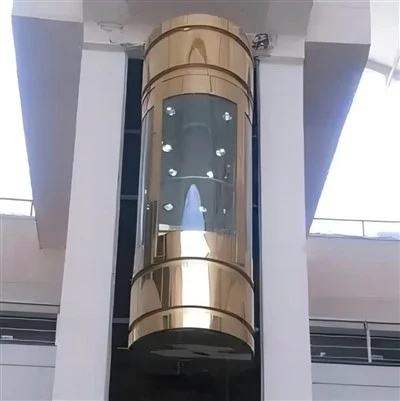
Hey there! As a supplier of passenger elevators, I'm super stoked to chat with you about the safety interlocks in these amazing machines. Safety is, hands down, the most crucial aspect when it comes to passenger elevators, and safety interlocks play a vital role in keeping everyone safe.
Let's start with the door interlocks. You know, every time you step into an elevator, the doors open and close smoothly. Well, that's not just by magic. Door interlocks are designed to make sure the elevator car doesn't move unless the doors are fully closed and locked. There are usually two main types of door interlocks: mechanical and electrical.
Mechanical door interlocks are like the old - school reliable guards. They use physical mechanisms to hold the doors shut. When the elevator is at a floor, the mechanical interlock releases, allowing the doors to open. Once you're in or out and ready to go, the doors close, and the interlock engages again. This physical connection ensures that if something tries to force the doors open while the elevator is in motion, it won't work.


On the other hand, electrical door interlocks work in tandem with the mechanical ones. They send signals to the elevator control system. If the electrical connection of the door interlock is broken, say if a door is not fully closed or there's a fault, the control system will immediately stop the elevator from moving. It's like a failsafe on top of a failsafe.
Another important safety interlock is the overspeed governor. This little guy is like a speed cop for the elevator. The overspeed governor is connected to the elevator car by a rope. As the elevator moves up and down, the governor rotates at a speed proportional to the elevator's speed.
If the elevator starts to move too fast, beyond a pre - set safe speed, the overspeed governor kicks into action. It activates a braking mechanism. This braking mechanism can either grip the guide rails of the elevator shaft or engage a mechanical device that stops the elevator car. It's a critical safety feature because an out - of - control, speeding elevator can be extremely dangerous.
The buffer is also an essential part of the safety interlock system. You can think of it as a big, soft pillow at the bottom of the elevator shaft. In case the elevator somehow free - falls or descends too rapidly and reaches the bottom, the buffer absorbs the impact. There are different types of buffers, such as hydraulic buffers and spring buffers.
Hydraulic buffers are great because they can absorb a large amount of energy smoothly. They work by forcing hydraulic fluid through small orifices, which slows down the impact. Spring buffers, on the other hand, use springs to absorb the shock. They're simpler in design but are more suitable for lower - speed elevators.
Now, let's talk about the limit switches. These switches are placed at the top and bottom of the elevator shaft. Their job is to tell the elevator when it's reached the end of its travel. When the elevator car approaches the top or bottom floor, the limit switches send a signal to the control system. This signal stops the elevator from going any further. It's a basic but very important safety measure to prevent the elevator from crashing into the end of the shaft.
There are also safety interlocks related to the hoisting ropes. Elevators are usually supported by multiple hoisting ropes. Each rope is equipped with a tension monitoring system. If one of the ropes loses tension or breaks, the monitoring system detects it. Once detected, the elevator control system will stop the elevator and notify maintenance personnel. This is crucial because a single rope failure could potentially lead to a disaster if not addressed immediately.
In addition to these, there are safety interlocks for the elevator doors at each floor. The landing doors have their own interlock systems. These interlocks ensure that the landing doors can only be opened when the elevator car is at that floor and the doors are properly aligned. This prevents people from accidentally falling into the elevator shaft when the car isn't there.
As a passenger elevator supplier, we take these safety interlocks very seriously. We make sure that all our elevators, whether it's a Hydraulic Passenger Lift, a Commercial Passenger Elevator, or a Small Passenger Lift, are equipped with the latest and most reliable safety interlock systems.
We use high - quality materials and state - of - the - art technology to manufacture these safety interlocks. Our team of experts conducts rigorous testing on every elevator before it leaves the factory. We test the door interlocks, the overspeed governor, the buffers, and all the other safety features to make sure they work perfectly.
We also offer regular maintenance services to keep the safety interlocks in top - notch condition. Over time, wear and tear can affect the performance of these safety features. Our maintenance technicians are trained to identify and fix any potential issues with the safety interlocks before they become serious problems.
If you're in the market for a passenger elevator, whether it's for a residential building, a commercial complex, or a small business, safety should be your top priority. And that's where we come in. We're committed to providing you with elevators that not only offer smooth and efficient transportation but also ensure the highest level of safety.
If you have any questions about our passenger elevators or the safety interlocks, don't hesitate to reach out. We're here to help you make the right choice for your building. Whether you need more information about the Hydraulic Passenger Lift, want to know the features of our Commercial Passenger Elevator, or are interested in our Small Passenger Lift, we're just a message or a call away. Let's start a conversation about how we can meet your elevator needs safely and efficiently.
References
- Elevator Safety Standards Handbook
- Guide to Passenger Elevator Maintenance and Safety