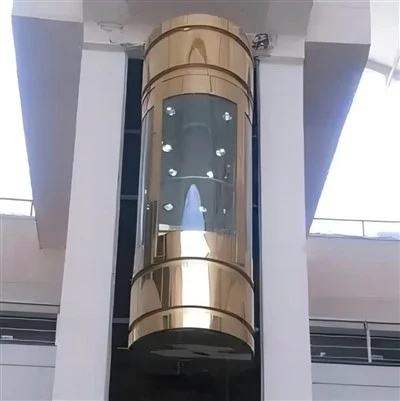
As a supplier of Vacuum Passenger Lifts, one of the most frequently asked questions we receive is about the installation height limit for these innovative vertical transportation solutions. In this blog post, I will delve into the factors that determine the installation height limit of Vacuum Passenger Lifts, compare them with other types of passenger elevators, and provide insights based on our experience in the industry.
Understanding Vacuum Passenger Lifts
Vacuum Passenger Lifts operate on a unique principle compared to traditional elevator systems. Instead of relying on cables, counterweights, and hoistways, these lifts use air pressure differentials to move the elevator car up and down. The system consists of a sealed tube with a car inside. By creating a vacuum above the car and allowing air to enter below it, the car is propelled upwards. Conversely, to move downwards, air is released from below the car while maintaining a partial vacuum above.
This technology offers several advantages, including a compact design, energy efficiency, and the ability to be installed in various locations where traditional elevators may not be feasible. However, like any technology, it has its limitations, especially when it comes to installation height.
Factors Affecting the Installation Height Limit
1. Air Pressure Differential
The primary factor that determines the maximum installation height of a Vacuum Passenger Lift is the air pressure differential that can be safely and effectively maintained. As the lift ascends, the air pressure above the car decreases, and the pressure below must be carefully regulated to ensure smooth and safe operation. At higher altitudes, the available air pressure differential becomes smaller, which can limit the lift's ability to move the car upwards.
Engineers typically design Vacuum Passenger Lifts to operate within a specific range of air pressure differentials. Beyond a certain height, the system may not be able to generate enough force to lift the car, or the pressure changes may become too extreme for the lift's components to handle safely.
2. Structural Integrity
Another crucial factor is the structural integrity of the lift's components. As the height increases, the forces acting on the lift tube, car, and other components become more significant. The tube must be able to withstand the pressure differentials and the weight of the car and its passengers without deformation or failure. Additionally, the seals and gaskets that maintain the airtightness of the system must be able to function effectively at higher altitudes.
Our engineering team conducts extensive structural analysis and testing to ensure that our Vacuum Passenger Lifts can safely operate at the specified height limits. We use high-quality materials and advanced manufacturing techniques to build robust and reliable lift systems.
3. Safety Considerations
Safety is always our top priority when designing and installing Vacuum Passenger Lifts. At higher installation heights, the potential risks associated with malfunctions or emergencies increase. For example, in the event of a power failure or a pressure loss, the lift must be able to safely stop and evacuate passengers.
To address these safety concerns, our Vacuum Passenger Lifts are equipped with multiple safety features, such as emergency brakes, backup power systems, and communication devices. These features are designed to ensure the safety of passengers at all times, regardless of the installation height.


Comparison with Other Types of Passenger Elevators
1. Commercial Passenger Elevators
Commercial Passenger Elevators are commonly used in high-rise buildings, shopping malls, and other commercial establishments. These elevators typically use a traction system, where a motor-driven sheave pulls the elevator car up and down using steel cables.
Compared to Vacuum Passenger Lifts, Commercial Passenger Elevators can generally be installed at much greater heights. This is because the traction system is not limited by air pressure differentials and can handle the weight of the car and its passengers more effectively. However, Commercial Passenger Elevators require a larger hoistway and more complex installation and maintenance procedures.
2. Traction Passenger Elevators
Commercial Passenger Elevators and Traction Passenger Elevators are essentially the same type of elevator, with the traction system being the most common technology used in modern passenger elevators. Traction Passenger Elevators are known for their high-speed operation and ability to serve tall buildings.
Similar to Commercial Passenger Elevators, Traction Passenger Elevators can be installed at greater heights than Vacuum Passenger Lifts. However, they also require more space, energy, and maintenance. Vacuum Passenger Lifts, on the other hand, offer a more compact and energy-efficient alternative for low to mid-rise buildings.
Typical Installation Height Limits for Vacuum Passenger Lifts
Based on our experience and the current state of technology, the typical installation height limit for our Vacuum Passenger Lifts ranges from 3 to 5 floors, which is equivalent to approximately 10 to 15 meters. This height range is suitable for a wide variety of applications, including residential buildings, small commercial buildings, and public facilities.
However, we are constantly researching and developing new technologies to increase the installation height limit of our Vacuum Passenger Lifts. Our engineering team is exploring innovative solutions, such as improved air pressure control systems and lightweight materials, to overcome the current limitations and make Vacuum Passenger Lifts a viable option for taller buildings.
Why Choose Our Vacuum Passenger Lifts
Despite the installation height limit, our Vacuum Passenger Lifts offer several unique advantages that make them an attractive choice for many customers.
1. Compact Design
Our Vacuum Passenger Lifts have a compact footprint, which means they require less space compared to traditional elevators. This makes them ideal for retrofitting existing buildings or installing in locations where space is limited.
2. Energy Efficiency
Vacuum Passenger Lifts are highly energy-efficient, as they use air pressure differentials to move the car instead of a motor-driven traction system. This results in lower energy consumption and reduced operating costs over the lifetime of the lift.
3. Easy Installation and Maintenance
Our Vacuum Passenger Lifts are designed for easy installation and maintenance. The modular design allows for quick and hassle-free installation, and the simple mechanical components require less maintenance compared to traditional elevators.
Contact Us for More Information
If you are interested in learning more about our Vacuum Passenger Lifts or have specific requirements for your project, we encourage you to contact us for a consultation. Our team of experts will be happy to answer your questions, provide detailed information about our products, and assist you in choosing the right elevator solution for your needs.
We look forward to the opportunity to work with you and provide you with a high-quality Vacuum Passenger Lift that meets your expectations.
References
- Elevator and Escalator Handbook, Third Edition by Joseph E. Shigley and Charles R. Mischke
- Principles of Vertical Transportation by Peter S. Powell